
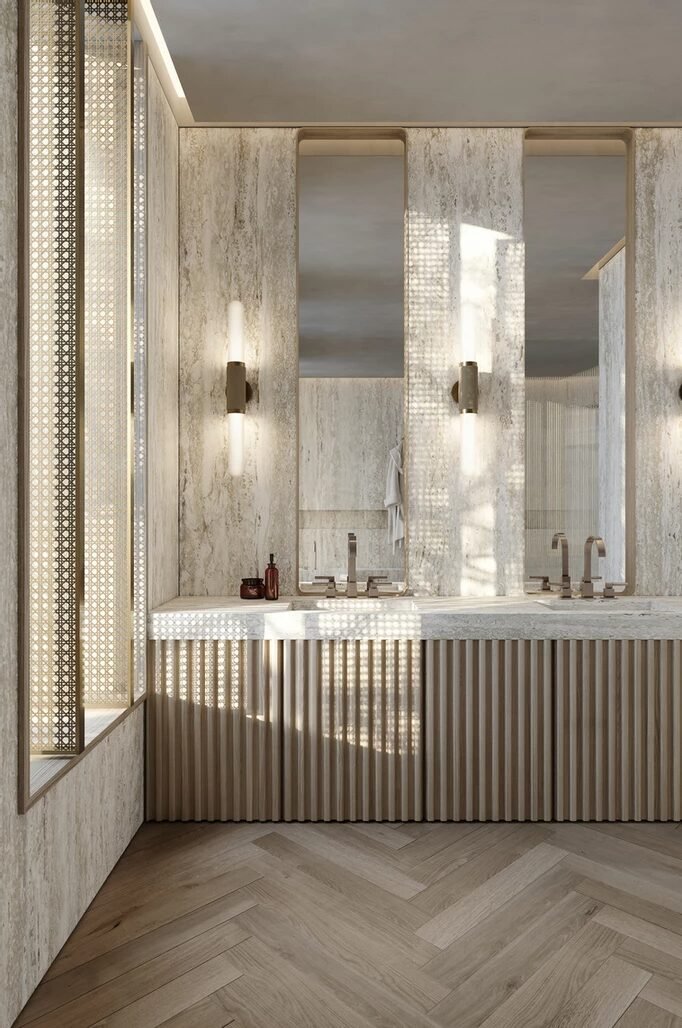
29 Bathroom Mirror Ideas Worth Stealing Right Now
Disclosure : This post may contain affiliate links or paid partnerships. I may earn compensation if you click a link or make a purchase, at no additional cost to you. See my disclosure for more info.
Let’s be direct about something.
The mirror is doing the most important job in your bathroom.
It’s larger than almost any other single element on the walls. Everyone looks at it every time they enter the room. It interacts with every light source in the space. It reflects and amplifies whatever is around it — for better or worse.
And most people pick theirs in about three minutes.
That’s why most bathrooms look the way they look.
The bathrooms that feel different — that stop you in your tracks, that you keep thinking about — they all have mirrors that were chosen with intent. Not necessarily expensive. Not necessarily rare.
Just deliberate.
Here are 29 specific ideas — sorted, direct, and ready to use. No filler. No vague advice.
Shape First: Mirrors That Break the Default
Every bathroom is already full of rectangles. Rejecting that default is the fastest path to a more interesting space.
Curves against a grid of right angles create the contrast that makes a room feel designed.
An arched mirror does this more quickly and more cheaply than almost any other single change you can make to a bathroom. No construction. No tradespeople. Just a new mirror hung where the old one was.
2. The organic-outline mirror.
Flowing. Irregular. Sculptural in the most literal sense.
Placed in a small bathroom, this becomes the first thing anyone looks at — not just for reflection, but as an object. Mirrors that people notice as objects are mirrors that upgrade a room.
A shape that reads as refined without being fussy. Timeless without being boring.
Over a pedestal sink, the pairing is nearly perfect — graceful and balanced. Nothing about it tries too hard, and that’s exactly its strength.
Six sides. The shape that says modern without shouting it.
Geometric and structured, but with enough natural logic in the shape to avoid feeling cold or industrial. The smart pick for a contemporary bathroom that still wants to feel warm.
5. The cathedral-top mirror.
Tall and narrow with a peaked crown — an architectural borrowing from old European windows.
In a bathroom where the ceiling feels low or the room feels compact, this shape draws the eye upward and creates a sense of vertical expansion. Inexpensive. Highly effective.
Frames: The Detail That Defines the Mirror
The frame determines what the mirror communicates. Get this right and almost nothing else in the room needs to work as hard.
6. The substantial natural wood frame.
The single most effective antidote to the sterile white bathroom.
Wood is the only material in most bathrooms that isn’t manufactured. It reads organic, it introduces warmth, and it makes a room feel inhabited rather than installed. One wood-framed mirror changes the temperature of an entire bathroom.
7. The thin black metal frame.
The one that works everywhere, always.
Slender black metal is essentially stylistically neutral — it adapts to whatever surrounds it. Minimal, industrial, traditional, or transitional — black metal frames fit without forcing. They never look like a compromise.
Gold, brass, or antique bronze — each with a slightly different personality, all with the same result.
Metallic frames catch light and radiate warmth in a way that wood and painted frames can’t replicate. They make inexpensive mirrors feel curated and expensive. The value-to-impact ratio here is nearly unbeatable.
9. The reclaimed wood frame.
Raw. Textured. The kind of thing that looks like it was found, not purchased.
Weathered grain and rough edges introduce genuine character into a space that might otherwise feel impersonal. When everything else in the bathroom is smooth and new, something worn is the counterpoint that makes the room interesting.
The texture option. Handcrafted, tactile, visually complex.
A woven natural fiber frame does what no other material in a bathroom can do — it introduces a tactile dimension that makes the room feel layered, not just decorated. Coastal adjacent, bohemian adjacent, universally livable.
Scale Up: What Oversized Mirrors Actually Do
One piece of guidance that pays off every time:
Size up before sizing down.
An undersized mirror floats awkwardly on its wall. An appropriately large — or even slightly oversized — mirror takes command, bounces light, and gives the room a sense of deliberate composition.
11. The floor-to-ceiling mirror.
The closest thing to a free square footage expansion available in a bathroom.
Full-height mirrors double the perceived depth of a room. Light disperses differently. Cramped layouts feel open. If your bathroom feels too small and you want to do something about it without a renovation, this is the answer.
Bigger than you think you need. That’s the correct scale.
Above a vanity, a generously-sized round mirror becomes the room’s anchor. It creates a clear focal point without the heaviness that an oversized rectangle can carry.
13. The vanity-width horizontal mirror.
Single panel. Edge to edge. Uninterrupted glass.
Above a double vanity, this is the detail that elevates a bathroom from “nice” to “exceptional.” Seamless. Spa-like. Far less expensive than it appears.
Frameless: The Invisible Mirror Strategy
Sometimes removing everything extraneous is the right move.
14. The frameless flush-mount mirror.
No border. No decoration. Just glass on the wall.
In a minimal bathroom, a frameless mirror recedes. It reflects without competing. It expands the visual volume of the room without adding anything to look at.
The power of absence.
15. The frameless beveled mirror.
Still frameless, but the angled perimeter edge catches light in a distinctive way.
That bevel is a quiet but real distinction between “I never really chose a mirror” and “I chose this one.” Small design detail. Big difference in how the room feels.
16. The sculptural frameless mirror.
No border, no straight lines — a flowing, organic glass outline on the wall.
Art and utility in one. Personality a rectangle inherently cannot supply.
Illuminated Mirrors: Function and Atmosphere, Simultaneously
An illuminated mirror is where form and function overlap most completely.
It doesn’t just look good — it makes the whole bathroom work better.
17. The warm LED backlit mirror.
Diffused ambient light from behind the glass. Warm. Flattering. Entirely unlike a ceiling fixture.
Overhead lighting creates shadows — under the chin, beneath the eyes, on the sides of the face. Backlighting eliminates them. You look better. The room feels better. The morning starts differently.
This is the upgrade worth prioritizing above all others on this list.
18. The front-integrated LED mirror.
LEDs built into the mirror surface, facing outward.
Shadowless, even illumination. The kind of light that makes precision work — makeup, skincare, detailed grooming — genuinely easier rather than a squinting exercise.
19. The heated anti-fog LED mirror.
You get out of the shower. The mirror is clear. No wipe. No wait.
A heating element prevents fog from forming on the glass in the first place. It sounds small. It feels enormous once you’ve experienced it.
One week with one of these and you’ll forget what a foggy mirror was like.
20. The tunable-temperature LED mirror.
Daylight-balanced for mornings. Warm-toned for evenings. Switchable.
Your reflection finally matches the environment you’re dressing for. What looks correct under your bathroom’s warm glow will look correct under natural light. The problem this solves is surprisingly common.
Double Vanity: The Mirror Pairing Problem
Two sinks create more decisions than most people anticipate. Here’s how to handle each option.
21. Matched rounds above each sink.
Symmetry is dependable. Two identical circular mirrors, evenly spaced, create visual rhythm and balance above the vanity. Unlikely to disappoint. Easy to execute.
22. Matched finish, varied shape.
Consistent metal tone, intentionally different silhouettes. One arched, one round. One oval, one rectangular.
The finish creates cohesion. The different shapes create interest. The result feels collected, not mismatched.
Matching everything reads as coordinated. Mixing thoughtfully reads as curated.
23. One broad mirror covering both sinks.
Continuous. No gaps. The entire vanity reflected in a single unbroken pane.
The effect is seamless and luxurious. It’s the approach high-end hotels rely on for a reason — it simplifies the visual field and makes everything look larger.
Placement Ideas That Most Bathrooms Never Try
Changing where the mirror lives can change the room as much as changing which mirror it is.
24. Leaned on the counter, not hung on the wall.
Propped and angled. Deliberately unstudied.
This approach gives a bathroom a relaxed, editorial quality — styled without trying. Use museum putty under the base for practical stability beneath the casual appearance.
25. Over the window, not beside it.
Positioned directly above the window — overlapping or fully covering it.
Daylight sneaks around the mirror’s edges and creates a subtle, glowing halo effect. Unusual. Atmospheric. Almost nobody tries this.
26. Diagonal in a corner.
For tight bathrooms where flat wall space is genuinely scarce, angling a mirror into the corner solves the spatial problem while creating an interesting visual angle.
The result looks intentional. Because it is.
Storage-Integrated Mirrors: Problem-Solving Behind Glass
Clutter on bathroom surfaces is a styling problem with a structural solution.
27. The recessed mirrored cabinet.
Not your parents’ medicine cabinet.
Current versions are flush with the wall, frameless, and soft-close. From the outside, they appear as a beautifully chosen mirror. Open them: organized storage for everything that used to clutter the counter.
The cleanest counter is not the emptiest one — it’s the one with the best hidden storage.
28. The mirror with an integrated shelf.
A narrow ledge beneath the mirror’s lower edge. Just enough for a few objects.
A candle, a small plant, a perfume bottle. The shelf creates a micro-composition right where the eye naturally lands. A small touch that makes the whole wall feel finished.
The Wildcard Entry
29. A found vintage mirror.
This is the difference between a bathroom people find attractive and one they find genuinely memorable.
An old mirror — market find, estate sale, antique shop — in a modern bathroom creates the productive tension between old and new that good interiors rely on.
Slightly imperfect glass. Real patina. An ornate or unusual frame against clean contemporary surfaces.
The contrast earns attention. And because no two vintage mirrors are identical, the result is inherently one-of-a-kind.
What to Check Before You Buy
A few things that commonly go wrong — avoid these:
Too high. Center the mirror at standing eye level. Above that and the proportions of the vanity wall feel off in a way that’s hard to correct without re-hanging everything.
Too narrow. Measure the vanity first. The mirror should come close to the vanity’s width. Never less than 60% — anything below that looks like an oversight.
Poor lighting interaction. A great mirror under bad light performs poorly. Think about the light source in relation to the mirror’s position before committing to either.
Style without utility. If your reflection is unclear or distorted, the mirror is wall decor. Beautiful wall decor, perhaps, but the functional purpose is lost.
One Swap. Real Results.
The bathroom isn’t a complicated room to improve. It just requires care in the right places.
One intentional mirror is often enough to tip the whole room.
No contractor. No budget overrun. Just a single, considered choice in a spot that every person who uses the room will look at every single time.
You have 29 starting points here. One of them fits your space.
Pick it. Buy it. Hang it.
Then notice how much better the room feels — and how much you’ll wonder why you waited.
There is no version of “fine” worth keeping when this is the alternative.