
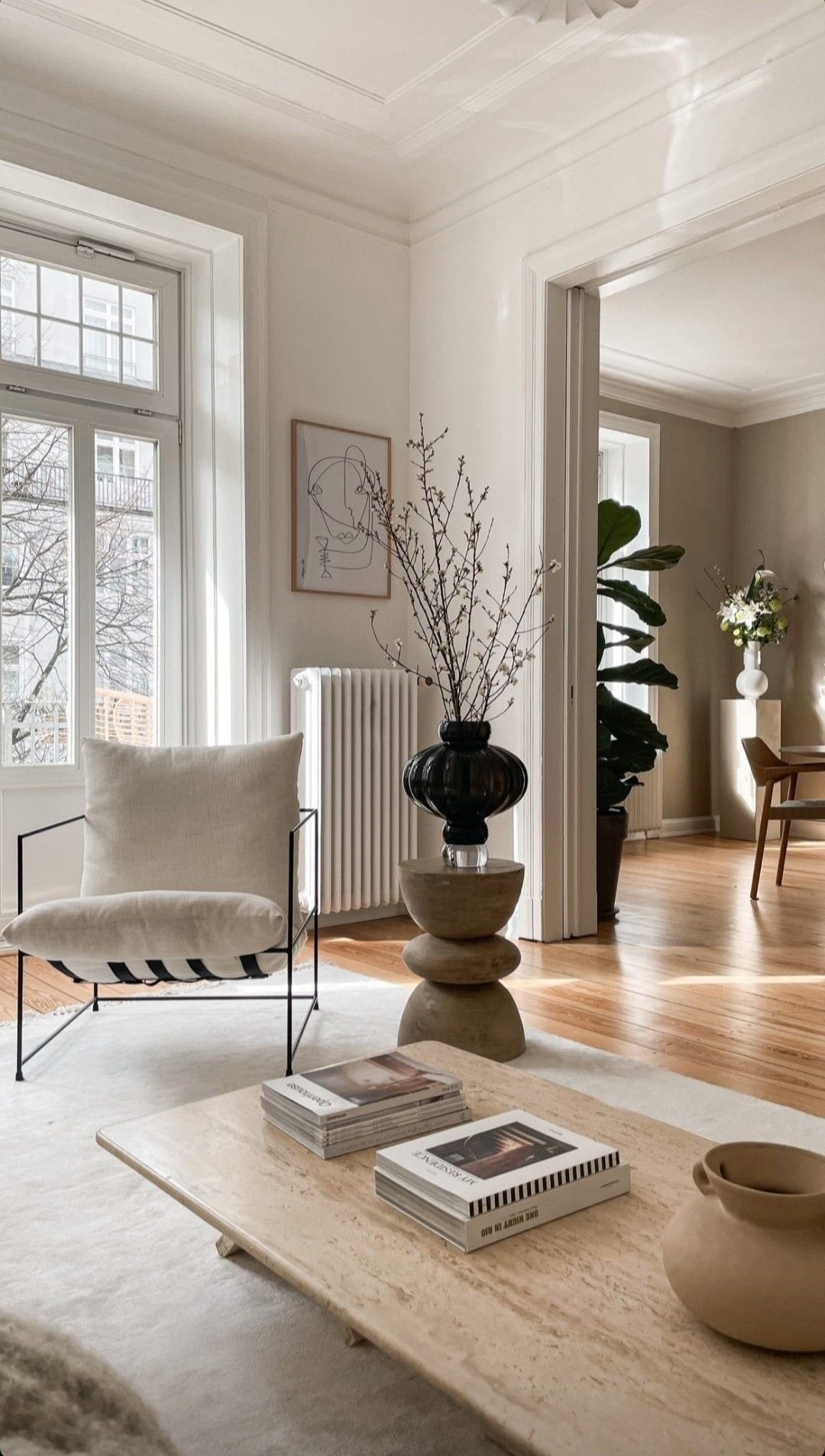
33 Scandinavian Living Room Ideas: A Complete Guide to Nordic Interior Design
Disclosure : This post may contain affiliate links or paid partnerships. I may earn compensation if you click a link or make a purchase, at no additional cost to you. See my disclosure for more info.
Scandinavian interior design isn’t a trend. It’s a philosophy.
It asks a simple question of everything in the room: does this need to be here? If the answer isn’t immediate and confident, the piece goes.
The result is spaces that feel deliberate, serene, and somehow effortless — even though the effort behind them is anything but.
These 33 ideas decode that philosophy and translate it into moves you can actually make in your own living room.
The Right Furniture Foundation
Scandinavian furniture design operates on a single principle: function and beauty are not separate categories.
1. Begin with a low, linear sofa in natural fabric.
Long proportions. Tapered legs. Machine-washable linen or cotton covers. Nothing over-designed. The Nordic sofa is defined by what it leaves out, not what it includes.
2. Commit to a real wood coffee table with honest material character.
Oak. Walnut. Ash. Rounded edges. A light natural oil finish. The surface should show its grain and absorb a little of life — material honesty is the point.
3. Source a single mid-century lounge chair and let it stand alone.
Boucé or structured wool. Pale wood legs. One chair, not two. In a Nordic room, the singular has more power than the paired.
4. Install open-frame wall shelves and populate them sparingly.
Slim profile. Visible wall behind each display. Objects: one plant, two books, one ceramic. The empty space is structural, not accidental.
5. Mount the media unit rather than placing it on the floor.
A floating media console in light wood. No visible legs, no floor contact. The room reads as larger and cleaner immediately.
6. Purchase only furniture that does two things.
A storage bench as seating and concealment. A stool as seat and surface. Nordic living rooms don’t accommodate anything that only justifies itself aesthetically.
Composing a Nordic Color Palette
The palette is the room’s first decision. Everything builds from it or breaks against it.
7. Select whites with warm undertones as the primary base.
Cream, linen, or cotton white — anything with yellow or pink beneath, never blue. Test in natural light before committing. The undertone determines whether the room feels like shelter or a lab.
8. Build secondary weight from greige.
A feature wall or a sofa in that precise zone between gray and beige. Greige reads as neutral but carries substance — the room gains gravity without weight.
9. Restrict accent colors to muted earth tones.
Dusty pink. Warm sage. Pale clay. Each one appears once or twice, never more. These tones animate without asserting.
10. Apply black in exactly three locations.
A lamp base. A mirror frame. A cushion edge. Three points of black create definition. More than that shifts the conversation into a different aesthetic register entirely.
11. Resolve flatness with material variation, not additional hues.
When white feels insufficient, introduce texture: linen, raw wood, woven fiber. The palette remains controlled while the room gains sensory complexity.
Integrating Natural Materials and Forms
Nordic design treats nature as a collaborator, not an accessory. Natural elements are load-bearing, not decorative.
12. Position one architectural plant as a room element.
Fiddle leaf fig. Monstera. Snake plant. A single specimen with genuine scale and presence, housed in a natural basket or ceramic. One commanding plant is worth more than ten ambient ones.
13. Place dried eucalyptus in a minimal white vase.
Longevity, fragrance, form. Three useful qualities from one simple object. It communicates taste without narrating it.
14. Display natural found objects as primary decor.
A smooth stone. A section of driftwood. A handcrafted wooden bowl. Objects formed by nature or by hand carry a kind of authority that manufactured goods cannot approach.
15. Organize coffee table surfaces using a round wooden tray as a containing frame.
Candle. Plant. Book. Inside the tray, they become a composition rather than a collection. The boundary is the editorial act.
Constructing Nordic Light
Light is not a finish. In Nordic interiors, it is a primary material.
16. Anchor the room with a sculptural overhead pendant.
Organic material. Natural form. This fixture governs the room’s emotional register from above. It sets the terms for everything beneath it.
17. Establish a secondary layer of ambient warmth from multiple sources.
Floor lamps. Table lamps. Sconces. Nordic rooms are illuminated from the perimeter inward — warm, multidirectional, never overhead-dominant.
18. Establish candle lighting as a daily ritual.
Grouped on a tray each evening. Not for occasions — for the ordinary hours that constitute most of life.
19. Treat natural light as an architectural element.
Remove obstructions. Hang sheer linen panels only if privacy demands it. The movement of natural light through the day is the most sophisticated design feature a room can have. It costs nothing. Block nothing.
Wall Treatment and Artwork
In Nordic rooms, walls contribute actively rather than serving as passive backdrops.
20. Hang one properly scaled artwork and resist adding more.
Abstract, photographic, or linear. Large enough to anchor the wall. One piece with correct scale does more compositional work than any gallery arrangement. Resist the urge to fill.
21. Treat one accent wall with limewash or microcement.
The resulting texture catches light differently throughout the day. It is subtle, handmade-looking, and impossible to replicate with standard paint.
22. Use timber picture ledges for art that can evolve.
Lean prints. Rotate seasonally. No additional fixings. The ledges offer commitment to the practice of displaying art without committing to any particular piece permanently.
The Disciplined Use of Accessories
Accessories in a Nordic room are edited, not accumulated.
23. Refresh the room’s character by starting with hardware.
Replace handles and pulls in brushed brass or matte black. Change the ceiling fixture. Low cost, high resolution — the room changes before furniture moves.
24. Limit the coffee table book collection to three volumes.
Beautiful spines. Meaningful subjects. Arranged with intention. The table is not a shelf.
25. Hang a minimal round wall clock.
Round, wood or matte black, legible numerals. A clock that belongs in a Nordic room is entirely unremarkable — and that’s exactly the point.
26. Allow stacked firewood to function as visual texture.
A black metal log rack with birch wood. This object belongs equally in a functional room and a purely decorative one — it reads the same way in both.
27. Define a reading corner with minimum elements.
One chair. One lamp. One sheepskin. Books. The reading nook doesn’t need to be announced. It simply needs to exist and be used.
28. Apply the one-in-one-out rule without exception.
Every acquisition displaces one existing piece. This rule is how Nordic rooms preserve their character indefinitely — not through periodic purges, but through constant small acts of editing.
29. Engage the sense of smell through natural soy candles and reed diffusers.
Cedar, pine, bergamot. Scent completes a room in a way that nothing visual can replicate. It is the final layer — and the one most often forgotten.
Textile Layering: The Craft of Softness
The right textiles transform a room from something you admire into something you inhabit.
30. Drape a chunky woven throw over the sofa without styling it.
One end bunched. The other fallen. It should look as if it’s been used today, because ideally it has been.
31. Allow a sheepskin or faux fur to settle naturally over the lounge chair.
Draped, not placed. The distinction matters. One looks designed; the other looks inhabited, which is better.
32. Recover sofa cushions in linen fabric in tonal variations.
Four to five. Linen is the textile of Nordic rooms for good reason — it ages correctly, breathes correctly, and feels precisely right in the hand.
33. Define the seating zone with an oversized flat-weave rug.
Natural fiber. Neutral tone. Sized so that no piece of seating furniture floats above bare floor. A rug scaled correctly resolves the room in a single move.
Restraint as Method
The most common failure mode in Nordic interior design is completion.
Attempting to finish the room all at once produces a room that never feels settled — because Scandinavian spaces are not meant to be finished. They are meant to evolve through intentional editing.
Begin with five decisions. Sit with them. Adjust. Then proceed.
The aesthetic rewards patience. It was built by cultures where patience is not considered a virtue — it is simply the way things are done.
On Starting
The room you want is not on the other side of a renovation budget or a design education.
It’s on the other side of a first decision, followed by a second, followed by a third.
Identify your starting point. Make that change. Observe. Then continue.
The Nordic living room is built exactly this way — incrementally, patiently, and with full attention paid to every choice along the way.