
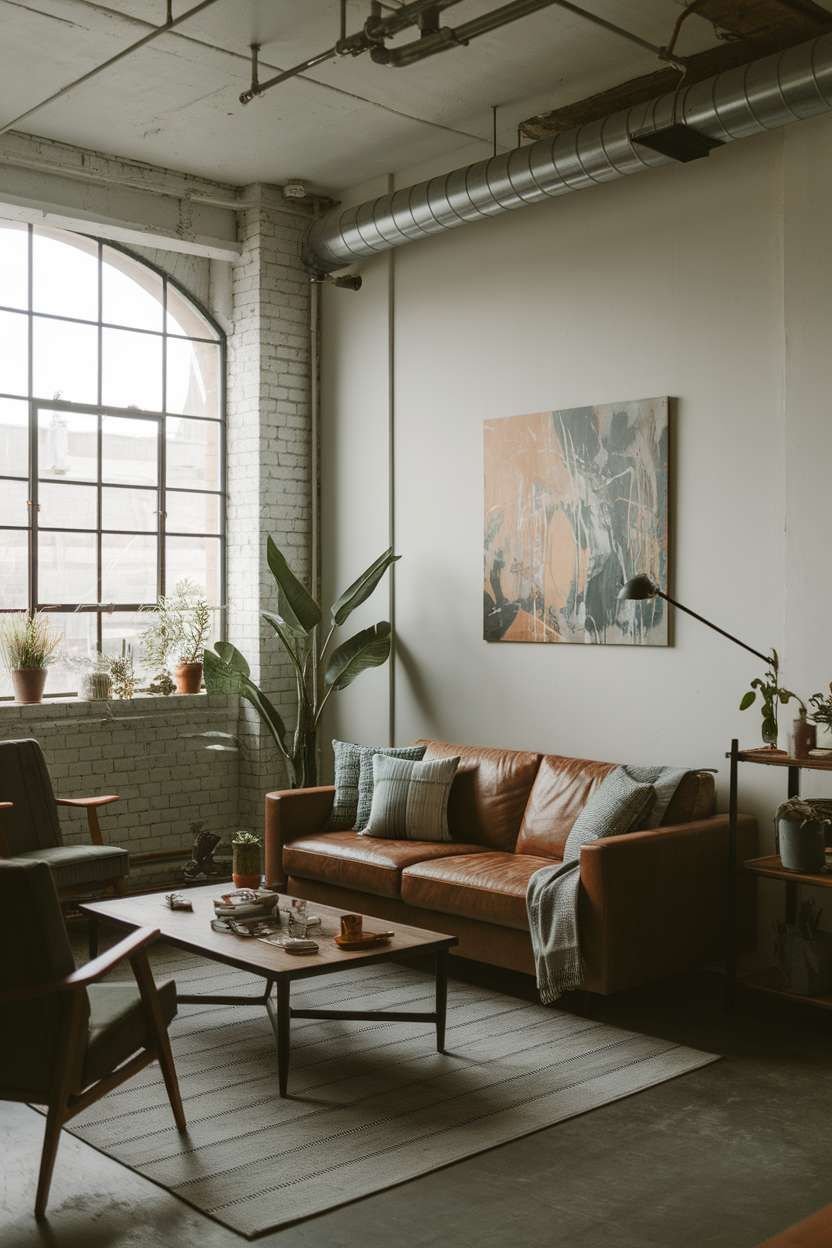
Concrete, Leather & Life – 39 Industrial Living Room Ideas Worth Stealing
Disclosure : This post may contain affiliate links or paid partnerships. I may earn compensation if you click a link or make a purchase, at no additional cost to you. See my disclosure for more info.
Something about your living room keeps nagging you.
Nothing dramatic. More of a persistent low note you can’t quite resolve. The room is livable, but it never quite feels like the place you imagined when you first thought about how you wanted to live.
Industrial design entered the picture somewhere. The raw textures, salvaged materials, exposed structure, industrial-weight pendant fixtures. Something about it feels right in a way that polished, decorated rooms don’t.
The problem? Every industrial room you find looks uninhabited. Stunning as photography. Miserable as a concept for actual daily life.
“I want that look. But I want to be able to exist in it.”
Here’s what most guides on this subject miss: warmth in an industrial room isn’t decoration — it’s architecture. The rooms that genuinely work build comfort into the same choices that create the industrial character. Soft against hard. Warm against cool. Human against mechanical.
These 39 ideas walk you through that process. Every idea on this list exists to bring industrial character and genuine livability into the same room.
Crafting a Lighting Setup With Real Atmospheric Range
Industrial lighting done poorly: one oversize bulb on a metal cord, dead center, nothing else.
What you get is not a lit room. You get one illuminated spot and a lot of ambient shadow.
Industrial lighting done right is a deliberate system — multiple sources, each carrying a different job in the room.
1. Install a cluster of pendant lights dropped to varying heights above the seating area.
A group of three to five pendants at different levels creates ceiling rhythm and avoids the flat quality of a single centered fixture.
2. Post a matte black directional floor lamp near the reading spot.
Industrial-style task lamps are both useful and visually strong. They read as sculpture when switched off and pull their full weight as a light source when on.
3. Pair warm brass or antique gold sconces on the wall beside the sofa.
Brass consistently surprises in industrial rooms. It takes the temperature of the room up several degrees without losing any of the material honesty the style is built on.
4. Extend bare filament bulbs along a ceiling run on a black cable.
Real filament bulbs, not imitations. Heavy black wire, not thin cable. The amber glow of actual filament transforms a ceiling into something you notice and appreciate.
5. Group pillar candles on a low metal tray on the coffee table for flame-based warmth.
Open flame does something electric lighting cannot. It moves. It flickers. It warms the air around it. Candles on a tray contribute more atmosphere than any fixture in the room.
Organic Materials That Soften the Industrial Edges
The fastest way to warm an industrial room that’s running cold?
Bring in living or naturally derived materials.
Organic forms break the dominance of hard surfaces immediately — not by competing, but by offering contrast at every level.
6. Put a large potted plant into a bare corner.
A monstera, rubber plant, or tall sansevieria in a woven basket planter fills vertical space with living warmth.
7. Line a metal wall shelf with a rotating collection of small plants.
Varied species, varied pot heights. A wall shelf becomes a pocket garden. The greenery reads against the industrial metal shelf in satisfying visual contrast.
8. Use a stoneware vessel filled with dried botanicals for maintenance-free texture.
Dried stems and branches give you the visual warmth of botanicals without the ongoing care requirement. Choose species with interesting silhouettes and display them simply.
9. Dot natural stone pieces around the space — a marble tray, a geode bookend.
Stone adds weight, visual calm, and natural material depth without drawing attention to itself. It belongs naturally in the company of iron and timber.
The Structural Foundations Every Industrial Room Needs
Design elements sit on top of architecture. The structural decisions shape every subsequent choice in the room. Lock these in first — they set the entire character of the space.
10. Expose a brick wall on one side and keep the rest of the room light.
Brick does its job on a single accent wall. Surrounding walls in a warm near-white prevent the room from feeling like a cave.
11. Finish concrete floors with a clear sealer before considering the job done.
Polished or sealed concrete looks like a design decision. Raw, unsealed concrete looks like an unfinished basement. The sealer is what changes the reading.
12. Install salvaged wide-plank timber flooring for added ground-level warmth.
No floor covering equals the warmth contribution of reclaimed wood. It brings character, texture, and history into every square foot of the room.
13. Use large-scale black steel-frame windows throughout the room.
Slim black steel frames are among the most architecturally powerful elements in industrial design. They maximize light and deliver factory-inspired line work at the same time.
14. Show the structural ceiling beams and treat them with a warm stain.
Exposed beams are an instant industrial signal. An amber or walnut stain brings warmth into the upper zone of the room and prevents the ceiling from feeling cold.
15. Claim the exposed plumbing and ductwork with deliberate matte black paint.
Visible mechanical systems are either an embarrassment or a feature — the distinction lives entirely in whether they’ve been treated intentionally. Flat black paint resolves this.
Furniture That Bridges the Industrial-Comfort Gap
Most industrial room failures happen here.
Metal frames everywhere. Hard edges on every surface. Nowhere soft to be. The room stops functioning as a home and starts functioning as an installation.
The fix is straightforward: for every hard material, introduce a soft counterweight.
16. Open with a deep, well-worn leather sofa as the room’s centerpiece.
Full-grain leather in tobacco or cognac develops character as it ages. A large, deeply cushioned sofa is the most impactful single warmth statement in an industrial room.
17. Build the seating area around a live-edge or slab-wood coffee table.
Natural timber edges introduce organic movement into all that angular geometry. Choose a piece with a genuinely unmanufactured silhouette.
18. Select fully upholstered armchairs in a lush material.
Heavy linen, velvet, or boucle. Place them across from the sofa. The fabric does the emotional heavy lifting — it’s what tells you the room is meant for use, not exhibition.
19. Style an iron-and-timber open bookcase with restrained, curated objects.
Leave visible gaps. Books at intervals, a ceramic object, one trailing plant. Sparse and open reads as deliberate. Dense and full reads as storage.
20. Station a leather steamer trunk near the seating as a functional accent.
Patina, storage, character. A trunk with real wear is one of the most authentic pieces you can bring into an industrial interior.
21. Pull a large woven pouf or floor cushion near the coffee table.
A woven pouf dismantles the seriousness of industrial design with a single gesture. It reads as casual, tactile, and entirely at home alongside metal and timber.
Color Language That Warms the Industrial Palette
The gray-and-black industrial room exists. It’s also the reason so many industrial rooms feel like winter is permanent inside them.
“Isn’t gray just the default for this style?”
It’s a default. Not a requirement. And not a good idea if warmth matters to you.
Color warmth needs to be woven in deliberately — not as an afterthought, but as a structural decision.
22. Paint walls in a warm white with just enough softness to push back cool tones.
Warm-toned whites handle light beautifully across day and evening. Blue-gray walls create a chill that no amount of soft furnishings can fully correct.
23. Bring rust, terracotta, and amber into the accessories and soft furnishings.
A terracotta planter. An amber glass. A burnt orange woven throw. These tones are naturally harmonious with brick, iron, and raw timber because they share the same earthy origin.
24. Let green appear consistently throughout the room’s color story.
Plants carry most of this automatically. Add depth with olive or forest green cushions or textiles. Green provides visual oxygen in a palette that can easily feel airless.
25. Apply matte black precisely and sparingly as a defining accent.
Frames. Lamp bases. A tray. Deliberate punctuation throughout the room. Matte black creates definition — but only when used with discipline. When it becomes everything, it becomes nothing.
Finishing Details That Lift the Room’s Overall Quality
These are the choices that separate rooms that look almost right from rooms that look completely intentional.
Small decisions. Visible results.
26. Swap standard switch plates for matte black or brushed brass versions.
One of the most effective and inexpensive upgrades in any room. Done in minutes. Noticeable immediately.
27. Face book spines into the shelf wall rather than outward.
Exposed page edges create a serene, unified texture across open shelving. Far more composed than the color chaos of facing spines.
28. Build a considered vignette on a board placed on the coffee table surface.
Board as base. Candle, small plant, one meaningful object on top. A deliberately constructed small composition gives the table purpose and presence.
29. Align all hardware finishes across the room to a single matte family.
Inconsistent finishes — especially the introduction of chrome — fracture industrial design at the detail level. One finish. Apply it everywhere. Hold the standard.
30. Top a large jute rug with a smaller faded vintage piece for layered floor texture.
Layered rugs add richness and material depth at the floor level. The base grounds the space; the vintage piece brings personality and history on top.
31. Resist restoring or replacing one genuinely worn object in the room.
A chip, a worn patch, a weathered surface. Industrial design’s soul is in its acceptance of time. Protect it.
Fabric Layers That Turn a Room Into a Home
There’s a version of an industrial room without any fabric. It’s called an empty warehouse.
Textiles are what transform architecture into a place where life happens.
32. Lay an oversized natural fiber area rug under the entire seating area.
Larger than your instinct tells you. Front legs of every major piece resting on it. A big jute rug is the warmest thing you can put in an industrial room below knee height.
33. Lay a thick knit blanket across the sofa arm or back.
It signals comfort. It signals welcome. It changes the emotional register of the room in the time it takes to toss it casually over the upholstery.
34. Stack linen, wool, and cotton cushions in an earthy, unmatched palette.
Cream, rust, slate, sage, clay. Mix the textures and dimensions deliberately. The goal is a look that says “gathered over time,” not “purchased together.”
35. Hang long linen curtains in a warm undyed shade from ceiling to floor.
Floor-to-ceiling curtains in natural linen soften the hardest industrial room without compromising the aesthetic one bit. They add warmth at the room’s edges where architecture often feels most austere.
Treating the Walls as a Design Opportunity
Textured surfaces — brick, concrete, aged plaster — carry their walls visually. Smooth drywall needs help.
36. Lead with a single large-format abstract piece in a pared-back frame on the focal wall.
Scale up and commit to one powerful statement. A thin timber or bare metal frame keeps the work centered without visual competition from the frame itself.
37. Create a gallery arrangement using frames in deliberately mismatched materials.
Black iron, light wood, warm brass. Different formats, different sizes, curated with care. A multi-piece gallery wall creates layered visual storytelling that a single piece never achieves.
38. Mount a large forged-frame mirror or an exposed-mechanism clock as a statement object.
Mirrors expand and lighten the room while staying industrial in material. Gear clocks are functional sculpture — they justify their position on the wall with both visual and practical purpose.
39. Prop selected pieces on a ledge or shelf rather than hanging them from the wall.
Leaned art suggests ongoing evolution. It’s a room that’s being lived in and added to, not one that was decorated once and sealed in amber. Exactly right for the industrial spirit.
The Room You Imagined Is Within Reach
You’ve already started. Picked up a piece here. Changed a choice there. The direction is correct.
The reason it hasn’t clicked yet isn’t lack of vision — it’s that warmth in an industrial room isn’t created by any single element. It accumulates through contrast and conversation between materials.
Soft answers hard. Warm responds to cool. Organic gives the geometric somewhere to breathe.
You don’t need all 39 of these ideas. You need the ones that fit your room and your life. Start with the one that feels most immediately right.
Layer in the next one when the moment arrives.
At some point you’ll walk in and the room will feel like yours. That moment arrives sooner than you expect when you’re building it one right decision at a time.
Pick one idea. Start this week.
The room has been patient. Now give it something to work with.
🔍 Focus Keyphrase: industrial living room ideas
📌 SEO Title: 39 Industrial Living Room Ideas That Feel Like Home
🔗 Slug: industrial-living-room-ideas
📝 Meta Description: Discover 39 industrial living room ideas that balance raw style with real warmth. From lighting layers to textiles — make the look truly livable.