
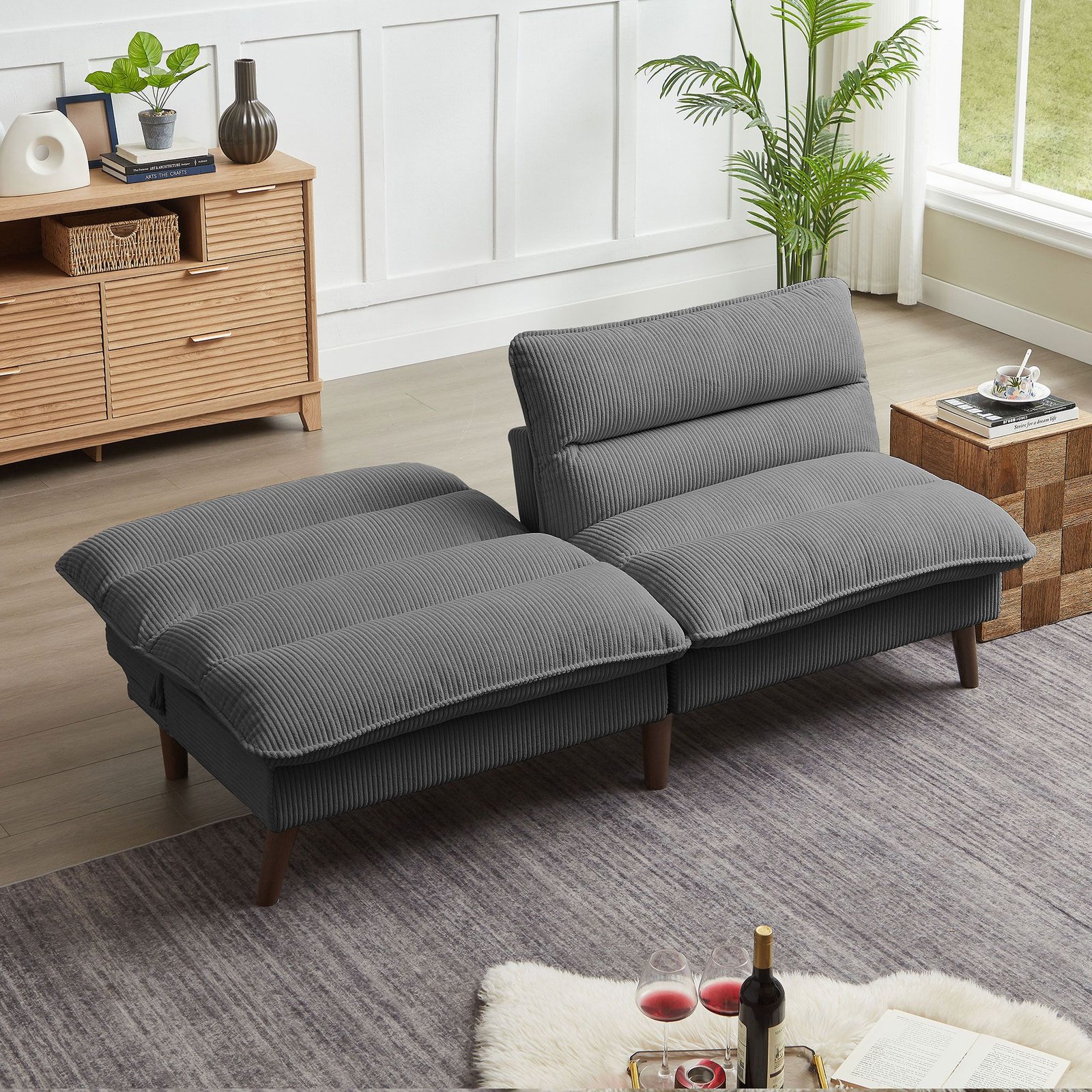
Why Does My Futon Look Bad? (And Exactly How to Fix It)
Disclosure : This post may contain affiliate links or paid partnerships. I may earn compensation if you click a link or make a purchase, at no additional cost to you. See my disclosure for more info.
You probably already know the answer isn’t “buy a better futon.”
And yet.
Every time you walk past the living room and glance at it, something feels wrong. Off. Like the futon doesn’t belong there, even though it’s been there for months.
You’ve already tried the obvious things. Moved it to a different wall. Added pillows. Bought a blanket specifically to throw over it. Browsed Pinterest for “how to style a futon” and got vague, unhelpful advice about “adding texture and warmth.”
Still looks wrong.
The frustrating truth is that the problem isn’t what you added. It’s the underlying approach — the framework for how the futon relates to the rest of the room. And nobody teaches that clearly.
Until now.
Interior architects don’t style rooms by instinct or aesthetic luck. They work from principles: proportion, flow, light, color logic, layering. Those principles are learnable. They apply to any furniture, including a futon.
Here’s a clear, step-by-step breakdown of exactly why most futon setups look off — and precisely what to do about it.
1) Is Your Futon Too Close to the Wall?
Yes. Almost certainly yes.
The instinct to push furniture against walls is almost universal, and almost universally wrong for creating a designed-looking room. A futon pressed flat against a wall reads as “stored,” not “styled.”
When an interior architect positions a seating piece, they treat it as geometry: a shape that actively defines the space around it, not a shape trying to take up as little space as possible.
Pull the futon away from the wall by at least a few inches. The shadow that forms in that gap gives the piece visual weight and makes it feel intentionally placed. If there’s a visible frame, this gap lets the frame breathe and be seen — and a frame that’s seen becomes a design element.
2) Is Your Rug Too Small?
Very likely. This is the second-most-common styling error in living rooms of all kinds.
A futon on a rug that only covers part of its footprint looks like it’s teetering. A futon with no rug looks like it was rolled in and abandoned.
The professional benchmark: the front legs of the futon sit on the rug. The rug extends past both sides and in front to form a visual container — a “seating zone” that the eye reads as organized and defined.
For texture without visual weight: a jute rug. For pattern interest without busyness: a flat-weave rug.
If you do nothing else after reading this, get the rug right. It reframes everything else in the room.
3) Are You Using the Throw Blanket Wrong?
Most people are.
The impulse is to spread the throw across the futon like a bed covering — flat, centered, edge to edge. This transforms a sofa into a cot visually and contradicts the very thing you’re trying to achieve.
The technique that works: fold the throw into a long, narrow panel — one-third the futon’s width. Drape it over a single armrest so it hangs asymmetrically down one side. Not centered. Not spread. Asymmetrical.
Why? Because symmetry reads as formal or staged. Asymmetry reads as natural confidence. It says “this was placed deliberately, not positioned for approval.”
Pair contrasting textures. Futon in a flat, smooth weave? Reach for a chunky knit or a linen throw. That textural contrast turns “throw blanket” into “styling detail.”
4) Are Your Pillows the Wrong Quantity or Configuration?
Probably one of the two.
Too many pillows of similar size and type: cluttered and commercial. Too few: bare and unfinished.
The designer target: three to five pillows, in odd numbers. Odd quantities avoid the symmetrical pairing that reads as showroom display.
Layer them. Large at the back against each armrest. Medium overlapping slightly in front. One small accent off-center — not in the middle.
Add material variety. A velvet pillow beside a coarser weave. A block color beside a quiet pattern. But the most underrated move is shape variation: work in a lumbar pillow among the square cushions. That one rectangle signals that someone with a trained eye assembled this arrangement.
5) Is There a Side Table Next to the Futon?
If not, add one. This is a gap that’s hard to see until you fix it, and then you can’t unsee it.
A futon without a side table is compositionally unresolved. Something is clearly missing to anyone who registers the space, even if they can’t name what it is.
A round side table against a straight-edged futon uses the contrast between circular and rectilinear forms — a reliable design technique. A wooden stool works on a tighter budget.
Height should match the armrest exactly: level, not taller, not shorter. Level makes the table feel like a deliberate part of the seating. Any other height makes it feel borrowed.
Keep the table surface simple: one small lamp, one candle, one additional small object. Three items. A composed vignette. Not a shelf full of things.
6) How Many Light Sources Are in the Room?
If your honest answer is “just the overhead,” that’s a significant part of the problem.
Overhead-only lighting is what architects call flat illumination: even, shadowless, clinical. It eliminates the visual depth that makes a room feel rich and designed.
Add a floor lamp to the futon’s seating area. Warm-spectrum — around 2700K — which produces the golden, inviting glow associated with comfortable, beautiful spaces.
Add a second source in a different area of the room: a table lamp on a shelf or surface, soft backlighting, indirect warm light. Two distinct sources create shadow, depth, and dimension that a single overhead fixture physically cannot.
Interior architects layer light across every project. This is not an aesthetic preference — it’s a spatial technique with consistent, reliable results.
7) What’s Happening on the Wall Behind the Futon?
If the answer is “nothing,” the futon will keep looking unfinished regardless of what else you do.
The wall behind a seating piece functions as its compositional backdrop — its frame. A bare backdrop tells the eye that the design isn’t complete.
Simplest resolution: one statement piece of art, centered above the futon, hung at eye level when standing. Not higher. Chronically high wall art is one of the most persistent styling mistakes — resist the instinct.
Alternatively: a gallery grouping of three to five pieces, kept within the futon’s width. Nothing spreading beyond the edges of the furniture below — that proportion rule is firm.
Or: a large round mirror that bounces light, opens the room visually, and creates a clean, strong focal point.
One choice. Done well. Not multiple choices layered together.
8) Can You Walk Freely Around the Futon?
Spatial flow is the foundation of good room design. It comes before aesthetics, not after.
A futon positioned so that passing it requires conscious maneuvering will make the room feel small and uncomfortable no matter how beautifully the futon itself is styled.
Keep at least 18 inches clear along the primary path through the room. If the room is on the smaller side, rotating the futon slightly off-axis can open up circulation significantly — more than you might expect from what looks like a minor adjustment.
Flow precedes everything. Get it right first.
9) Does the Room Have Any Vertical Elements?
Probably not enough.
Most living room furniture is horizontal — low seating, flat tables, wide rugs. A room of only horizontal elements feels dense and static, like everything is pressing down.
A tall plant beside the futon solves this directly. A fiddle leaf fig, monstera, dracaena, or snake plant draws the eye upward, introduces organic line, and changes the room’s visual rhythm.
Place it on the emptier side of the futon, or angle it into the nearest corner.
Single plant. Vertical counterpoint. That’s all it needs to accomplish.
Low-light environment? A quality faux plant carries the same visual and spatial benefit.
10) How Many Colors Are Competing in the Room?
If you can count more than three distinct colors in the living room — walls and white excluded — the palette may be working against you.
Multiple unrelated colors signal a room that happened over time without a plan. The eye scans and keeps scanning, never sure where to settle.
The fix is as simple as the diagnosis. Choose three colors and assign each a role:
A dominant color — the futon upholstery and rug, the largest visual surfaces. A supporting color — cushions and throw, reinforcing without competing. An accent color — appearing once, in a single object or artwork.
Three colors, clearly assigned. The room snaps into coherence.
11) Is the Coffee Table the Right Size and Distance?
These two variables — size and distance — are responsible for a lot of living rooms that “almost work.”
Distance: fourteen to eighteen inches between the front of the futon seat and the near edge of the table. This is the range that feels natural in use and looks balanced visually.
Size: a coffee table proportioned to roughly two-thirds the length of the futon. Shorter looks insufficient. Longer takes over the room.
Flexible alternatives for futon setups: two small nesting tables work beautifully in tight spaces and step aside easily. A round ottoman with a tray adds versatility — use it as a surface or as extra seating when needed.
12) Have You Planned for When the Futon Unfolds?
Most people haven’t. And then they’re surprised when the room falls apart the first time it needs to.
Check: does the futon have enough clear floor space in front to extend fully? Can the coffee table be moved in under a minute? Is there somewhere for the pillows and throw to go that doesn’t mean dumping them on the floor?
A basket or bin placed nearby — one that suits the room aesthetically — answers the last question. When the futon converts, the accessories go into the basket. The room stays organized. The transition takes twenty seconds instead of twenty minutes of disruption.
Style the futon for both modes. A room that only works as a sofa is only half-designed.
Your Futon Can Look Exactly the Way You Want It To
None of the problems covered in this guide require a new futon to solve. Not one.
Every fix is a question of application: the right rug in the right size, a throw deployed correctly, pillows arranged with intention, light layered rather than flooded, color used with discipline.
These are the principles interior architects apply to every project, regardless of budget or furniture category. They work on futons the same way they work on everything else.
Start with the tip that addresses your most obvious current gap. Do that one thing. Come back for the next.
You’ll surprise yourself with how quickly the room transforms.