
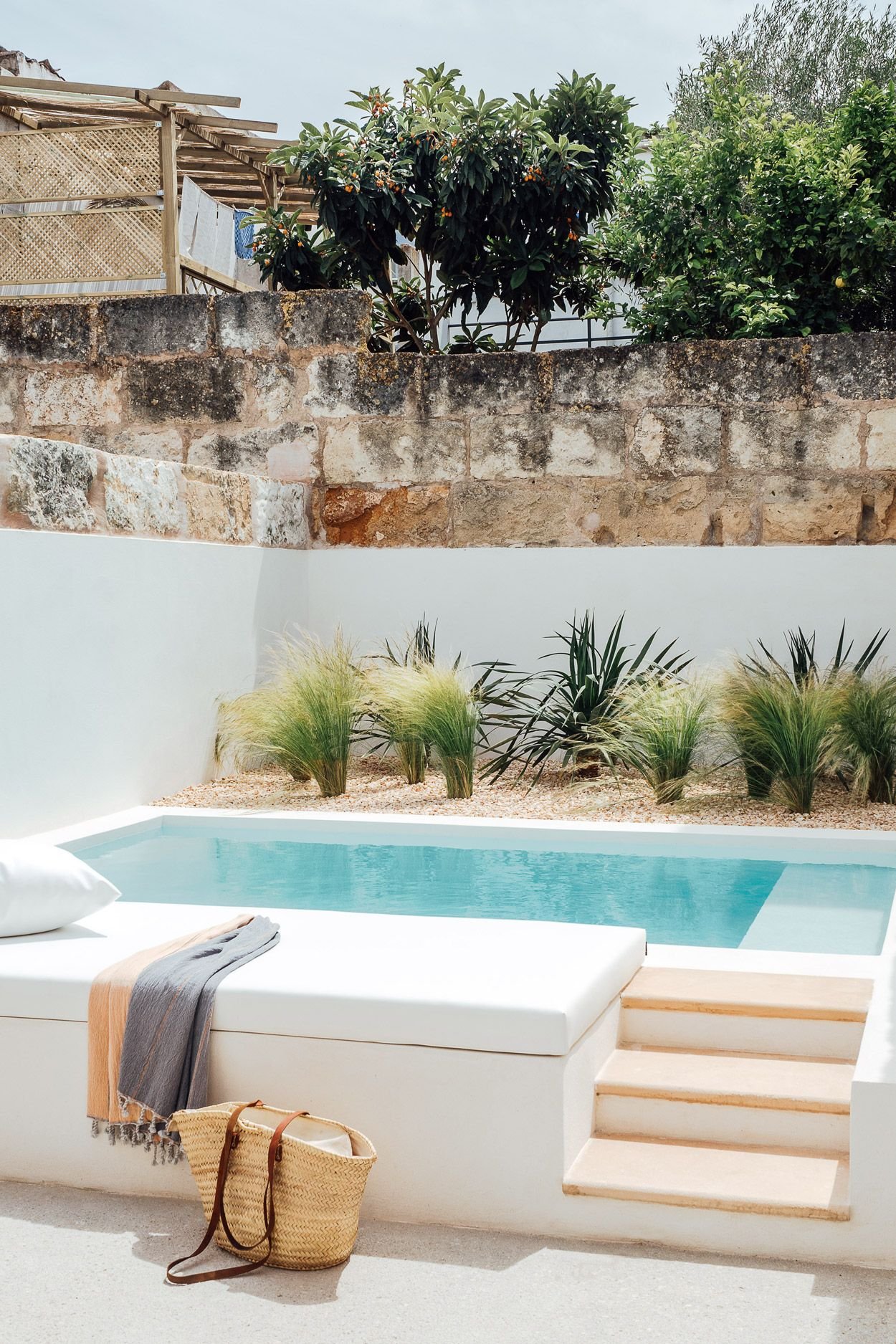
Which Plunge Pool Design Is Right for Your Backyard? 09 Options Worth Considering
Disclosure : This post may contain affiliate links or paid partnerships. I may earn compensation if you click a link or make a purchase, at no additional cost to you. See my disclosure for more info.
What if that underused corner of your yard could actually become somewhere you want to spend time?
Not hypothetically. Not someday. Right now, with your actual space and your actual budget.
A plunge pool tends to be the answer more homeowners than you’d expect land on. The possibility of a cool soak on a hot afternoon. An evening outside that feels like a genuine retreat. A backyard that pulls you toward it instead of one you walk past without thinking.
The hesitation usually comes down to cost, complexity, or a vague sense that the project is bigger than it really is.
What if it isn’t? A plunge pool is compact, purposeful, and built for real backyards — not the sprawling properties you see in renovation shows.
Here’s what each major design option looks like, what makes it work, and what you need to watch out for.
What Exactly Is a Plunge Pool?
Good question to settle early.
A plunge pool is smaller and typically deeper than a conventional backyard swimming pool. It’s built for soaking and cooling — not laps. Think more spa, less sports facility.
Most plunge pools fall between 6 and 15 feet in length. That range makes them genuinely viable for city backyards, courtyards, and compact suburban lots.
The smaller footprint means lower heating costs, easier upkeep, and a faster build than most people expect.
That last point tends to surprise people. In a good way.
1. The Natural Stone Plunge Pool
Does your garden already have a natural, organic character? Then this might be your answer.
A plunge pool surrounded by stone — flagstone, travertine, limestone — looks like it was excavated from the earth rather than installed in it. Uneven edges. Warm tones. Low plants edging their way through the gaps.
It belongs in cottage gardens, Mediterranean-inspired landscapes, and rural properties where a polished concrete design would look completely out of place.
Stone also stays cooler underfoot in direct sun than most paving alternatives. A detail that matters more on hot days than you might anticipate.
What makes this design compelling is its restraint. It earns admiration quietly. And in the outdoor space, that kind of understatement often has the most lasting appeal.
Surround it with landscaping rocks in natural tones, vertical garden panels along the fence, and a pair of chaise lounges on the stone deck for easy relaxation between dips.
2. The Plunge Pool With a Built-In Sitting Ledge
Have you ever wondered why some plunge pools feel immediately comfortable and others just feel like small pools you stand in awkwardly?
The answer is almost always an underwater sitting bench.
Without one, you step in and have nowhere purposeful to be. With one, the pool transforms into an immersive seating experience. Water at chest height. Somewhere to settle properly. The whole thing finally makes sense.
An L-shaped configuration takes it further, essentially building a social corner inside the pool. Picture that on a warm evening with friends.
This is one of the most underrated specifications in plunge pool design. It costs less to include than most people assume and makes more difference than almost any other single feature.
Add an in-pool stool at the edge for poolside sitting, a striped indoor/outdoor rug to anchor the deck zone, and patio side tables for keeping drinks within reach.
3. The Freeform Plunge Pool With Lush Tropical Plants
What if your backyard didn’t feel like a backyard at all?
A freeform plunge pool surrounded by dense tropical planting gets remarkably close to that experience. Curved pool edges. Palms overhead. Birds of paradise flanking the water. Oversized broad-leaved plants pressing in. A few well-positioned boulders for weight and texture.
The effect is complete sensory escape. Open the back door and feel the transition immediately.
There’s also a spatial benefit. Curved shapes read as more generous than rectangular ones in compact yards. Organic forms fool the eye in useful ways.
If your home already has a coastal or tropical character, this design will look like it was planned from the beginning. If it doesn’t, this might be the one that starts a new direction for the whole property.
Establish vertical scale with areca palm trees, add a cedar vertical garden for privacy and density, and hang outdoor globe string lights above for evenings that no one wants to end.
4. The Raised Concrete Plunge Pool
Working with a sloped yard? Here’s a design that turns that challenge into an asset.
A raised concrete plunge pool sits partially or fully above the existing ground level. The result isn’t a compromise — it’s a clean, contemporary structure that functions almost like outdoor sculpture.
Clad the exterior in stone, smooth render, or timber to match your existing palette. And those raised walls? They double as natural seating. Guests perch on the rim. Children dangle their legs. You rest a drink on the ledge.
Is there a cost advantage? Often, yes. Where the ground drops away from the house, a raised build can come in cheaper because deep excavation becomes unnecessary.
Pair with a louvered aluminum pergola alongside for shelter and spatial definition, and use an indoor/outdoor area rug in the seating zone to anchor the layout.
5. The Plunge Pool Woven Into a Deck
Why is this layout so consistently popular?
Because it collapses the boundary between your living space and the water. A timber or composite deck wraps the pool so seamlessly that the two feel like a single designed element. You step off the deck and directly into the pool. No transition. No edge to negotiate.
The deck becomes lounge area, dining space, and pool surround at the same time. It’s one of the most space-efficient outdoor layouts available.
The key to making it work is the flush rim detail: pool coping sitting level with the deck surface, everything reading as one continuous horizontal plane. Get that right and the visual expansion is real, not just implied.
One thing worth taking seriously: use slip-resistant decking material at the water’s edge. This is a safety decision, not an aesthetic preference. Wet feet on smooth composite boards lead to falls. Don’t discover this the hard way.
Teak pool chaise lounges and a shade sail complete the deck environment. A outdoor side table between loungers keeps things practical.
6. The Cocktail Plunge Pool Fitted With Jets
What if one pool could serve two entirely different purposes depending on the season?
That’s precisely what a cocktail pool offers. Also called a “spool” — part spa, part pool — it combines the compact footprint of a plunge pool with hydrotherapy jets and temperature control. Some versions include a dedicated warm zone at one end.
In summer: refreshing and cool. In winter: heated and therapeutic. One installation. Two very different experiences.
If you live somewhere where genuine cold weather arrives for months at a stretch, this might be the most sensible choice on this list. You won’t spend half the year looking at a pool you can’t use.
Standard dimensions — 10 to 12 feet — fit comfortably in most residential yards.
Add a large cantilever umbrella for year-round shade, reclining chaise lounges for easy water-to-sun transitions, and outdoor string lights overhead to extend the mood after dark.
7. The Glass-Paneled Plunge Pool
What happens when you make the side of a pool transparent?
Something genuinely unexpected. One or more clear acrylic panels replace the structural wall, letting you see the water column from outside. It’s theatrical in the best possible sense.
Glass-panel designs work best when the pool is raised or semi-raised, with the clear face oriented toward a seating area or primary garden view.
After dark, with underwater LED lighting inside the pool, the effect shifts from striking to visually extraordinary.
Is it expensive? Yes. Does it require engineering-grade materials and careful structural calculation? Absolutely. No point understating that.
But if you want a backyard that produces a visible reaction in every visitor who walks through the gate — this is the design that delivers it.
8. The Japanese-Inspired Deep Soaking Pool
What if the design removed everything that wasn’t essential?
A Japanese soaking pool answers that question with remarkable clarity. A rectangular basin. Dark stone. Perhaps a bamboo spout sending a quiet, continuous stream across the still water.
Japanese soaking pools have existed in refined form for centuries. Their logic prioritizes depth over surface area — sitting shoulder-deep in a pool barely 7 feet across is the intended experience.
Surround it with raked pebbles, ornamental grasses, and a simple timber screen for privacy. Leave negative space in the design. Let the quiet do its work.
The result doesn’t feel like a backyard feature. It feels like a spa that was already there.
Useful design note: dark tile absorbs solar energy more efficiently. In warmer climates, this translates to meaningful passive heating and reduced mechanical energy use. Worth considering in the specification.
9. The Courtyard Plunge Pool
What do you do with a narrow side passage or a walled courtyard that serves no practical purpose?
Most people dismiss these spaces before seriously considering them. This is almost always a mistake.
A slim rectangular pool — 5 feet wide, 12 feet long — can turn a space like that into the most-used area in the entire property. A vertical garden on the boundary wall. warm lights strung above. Two loungers alongside.
The transformation is out of proportion to the scale of the intervention. Dead space becomes sought-after space. It happens consistently.
This layout is particularly relevant for terrace houses and urban townhouses where a conventional pool simply can’t happen.
The constraint becomes the catalyst. It always does.
What Can Go Wrong — and How to Avoid It
What actually causes plunge pool projects to go sideways?
Several things. More often than people expect before they build.
Problem 1: No permit.
The assumption that a plunge pool is too small for formal approval is wrong in most jurisdictions. Any permanent in-ground water structure typically requires a building permit. Skipping the process exposes you to fines, removal orders, and title complications when you want to sell.
Contact your local building authority first. Before anything touches the ground.
Problem 2: Poor drainage design.
Every body that enters a plunge pool displaces water. Without properly engineered overflow management and site grading, that water finds its own path — usually toward your foundation or your neighbor’s garden. Solve drainage in the design phase.
Problem 3: Inadequate filtration.
Smaller water volume amplifies the impact of chemical imbalances. An underpowered filter produces consistent, recurring water quality problems. Specify a filtration and sanitation system sized correctly for the actual pool volume. This is the one investment that pays dividends every single day.
Problem 4: No shade.
A plunge pool sitting in direct sun all afternoon becomes uncomfortably warm. In summer, water temperatures in an unshaded pool can render it unpleasant precisely when you most want to use it.
Plan a shade sail, pergola, or large umbrella from the outset. You will use the pool more because of it.
How Do You Choose the Right One?
Three questions cut through the noise.
How much space? Measure it. Actually measure it. Visual estimates are almost always wrong.
How will you use it? Daily refreshment? Weekend social entertaining? Therapeutic year-round soaking? The honest answer steers you toward the right configuration.
What does your home look like? The pool that looks best is the one that belongs. A glass-walled modern pool beside a stone country house will always feel slightly off, no matter how well it’s built. Match the visual language of the property.
Answer those clearly and the right choice tends to become obvious.
What Would It Mean to Actually Love Your Backyard?
How many hours do you spend at home? More than you’d guess, probably.
And yet outdoor space — which is often a significant portion of what you own — goes underused by most people. Maintained just enough. Never fully realized.
A plunge pool is one of those additions that changes behavior, not just appearances.
It gives you a reason to step outside intentionally. To decompress. To have people over and actually enjoy the property you’ve invested in.
You don’t need a large lot. You don’t need an exceptional contractor. You don’t need a budget that makes you nervous.
You need a realistic plan, a design that fits what you actually have, and the decision to stop considering and start building.
Your backyard has been patient. What’s your answer?